
By Mesut Şenol
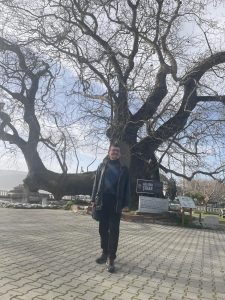
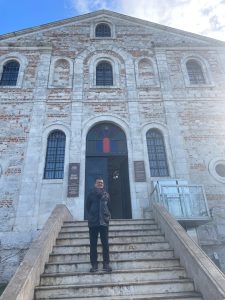
Fatma Hanım, one of the officials in charge of authors at Nilüfer Municipality, welcomed me at the Bursa Bus Terminal and brought me to Gölyazı. Before arriving at the Writers’ House (Yazıevi) Guest House, she took me on a short tour of Gölyazı, showing me the Weeping Plane Tree (Ağlayan Çınar), the bridge over the lake, the entrances to the peninsula, and places like the bakery and the grocery store. Afterwards, we entered the “Gölyazı Writers’ House,” located right next to the “Saint Panteleimon” Church, which has now been transformed into the “Gölyazı Cultural Centre.” Fatma Hanım walked me through all the rooms one by one, sharing information about the air conditioner, stove, oven, bathroom, and the ready-to-use spare food supplies.
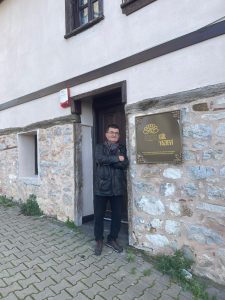
Yes, finally, with key in hand, I was in an environment where I could fully dedicate myself to writing, staying all by myself for a period of 15 days. Hosting authors domestically and internationally has many benefits. As you know, Bodrum was first introduced to the world through the immortal works written by the “Fisherman of Halicarnassus” in the field of literature. When a region is promoted through literary works, a solid foundation is laid. As in the case of Bodrum, coming to the forefront in the literary world was followed by a rapid leap forward in tourism. Although the Fisherman of Halicarnassus’ arrival, stay, writing, and life adventure in Bodrum took place on entirely different dimensions, I must confess that I began to feel my own residency at the Writers’ House as somewhat similar to his.
“Welcome, my author!”, “Will you give me a book, too?”, “Let’s see, what are you going to write?”
It turned out that even before I entered the Writers’ House, the entire population of Gölyazı had been eagerly waiting for their new author. After settling my belongings, I decided to take a short walk toward the Weeping Plane Tree and step along the path by the lake. As I walked down the street, older sisters and aunts at the pickle, olive, cheese, and pastry (börek) stalls lining both sides were calling out to me as if shouting to a relative from their own village. As someone who has traveled all over the Balkan countries, attended festivals there, and closely gotten to know the cultural and social structure of the people, the genuine warmth of these exchange-resident (mübadil) women made me very happy. Far from feeling like a stranger, I felt as though I had been embraced into their extended family circle. Indeed, another distinct feature of Gölyazı that I observed later was that it is one of those rare places where doors are left unlocked. The local people lived in such peace with one another.
Indeed, later on, when I finished my breakfast around mid-morning and went out for my usual walk, I saw those same lovely women at the forefront, with their husbands, daughters, and sons around them, setting up their stalls, arranging their goods impeccably, and meticulously cleaning and preparing their chestnut roasters and pastry griddles. I couldn’t help but say to myself, ‘This is it! A local community starting the day as a family, tackling their work together, bravo to them!’ The smiling faces that would welcome the tourists pouring in a little later were ready. Whether it was a young couple hand in hand, a couple with children on their own, or people driving by in their cars, a smile appeared on their faces as they encountered the unpressured, heartfelt words of welcome from those women. Of course, Gölyazı was taking a serious share of the regional tourism that has been shaped by tour groups over the years. The crowd walking under the guidance of a tour guide holding a flag at the head of the group—having stepped off the bus at the entrance parking lot to walk up to the Weeping Plane Tree—was also receiving their share of this affectionate greeting.
Those who came to the Weeping Plane Tree, with or without a guide, were posing for photos there, on the bridge between the lake and the peninsula, either with their own phones or holding up the local town photographer’s parrot in their hands.
Naturally, next came the restaurants. To taste the carp, pike, catfish, eel, and other seafood caught in the lake, one of Turkey’s limited water sources that is alive and sustains numerous living creatures, visitors were stepping into businesses, each embraced by the entire household. Intrigued, it seemed to me that those managing the restaurants were mostly the ladies of the house, because almost all the men had taken on the task of fishing in the lake with their small boats. The daily fish they brought in were cooked immediately and served to the tables. Meanwhile, let’s not forget: early in the morning at the Auction Place (Mezat Yeri) in the center of Gölyazı, fish were bought at extremely affordable prices by all local residents, especially restaurant operators. As I mentioned before, many restaurants were catching their own fish anyway. In fact, I could argue that the people of Gölyazı, almost like a cooperative society, widespreadly and generally provide their local people with the opportunity to eat fish at a very cheap price.
More than 80 percent of Gölyazı’s population consists of exchange residents (mübadil). Those who joined the Gölyazı clan from the outside through marriage or other means have adapted to them as well. Therefore, both the spirit of solidarity is very strong here, and straying from honesty is an attitude rejected and condemned by the entire community. For this reason, tourists coming here, who for many years have been overwhelmingly, almost entirely, domestic tourists, have no fear of being ripped off. Prices are extremely reasonable and almost at a certain standard. Moreover, whether it is a cafe or a restaurant, you can easily read the menus and prices on the large signs in front of them. Price lists are also an accessory on the mobile stalls of the women. Clearly, those who come here once come back again.
Actually, what impressed me the most regarding the lake is that it provides a habitat for many bird species. Apart from migratory birds such as the swan, pochard, and stork, around 30 birds have been identified. The fishermen know their names like the back of their hand. Mehmet Çınarlı, a fisherman and resident of Gölyazı, gave me a list of these birds. Due to the lake’s reeds and its living structure fed continuously by water sources, I would like to share with you the names of some of the other birds that are never lacking here: Pelican, Flamingo, Coot, Wild Ducks (Mallard, Red-crested Pochard, Tufted Duck), Wild Geese (Bean Goose, Bean Goose variant, Canada Goose), Reed Warblers, Divers/Grebes, Babiçe, Behri (Water Rail/Moorhen), Çaplek, Kingfisher, Greenfinch, Pintail, Heron (White-crested Heron, Grey Heron), Night Heron, Cormorant, Starling, Crow, Dove, Pıçancık, Nightjar, Blackbird, Bee-eater… IFSAK photography artists and scientists have prepared the catalogs of these birds in the finest way. I realized for a moment that I envied Mehmet Çınarlı, who said that living together with all the birds in the lake since childhood added years to his life, and his fisherman friends.
I envy them because during my walks by the lake, a deep sense of peace enveloped me as I listened to the magnificent symphonic choir created by the birds listed above. I am certain that those who fish while listening to these concerts, accompanied by frogs, eels, and water snakes, have turned into individuals whose musical taste has become refined and developed.
I also hear the musical version of the phrase “Welcome, my author!” in the voices of the inhabitants inside the lake during my walks along the shore twice a day. As a writer and translator, I think each time that it is my duty to understand and convey what they want to say. The shared life order established by the people of Gölyazı with the living creatures inside and on the lake is amazingly valid in the neighborhood streets as well. Roosters crowing relentlessly day and night, hens broadcasting to the surroundings with joy and pride as soon as they lay eggs, geese patrolling in pairs through the side streets by hissing and sometimes making high-volume low-pitched sounds, dogs that lie down on the ground in front of you to have their bellies rubbed but keep communicating with each other all night until morning, and cats entering different psychologies in certain seasons, all of these clearly do not hinder the sleep of the Gölyazı residents even a bit. I got used to it in a short time too. Where else could I find the most organic musicians that nature offers us on the lake and on land!