
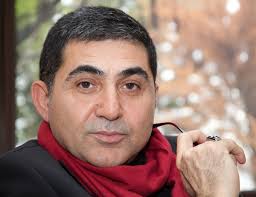
TUĞRUL KESKİN
He was born in the Aralık district of Iğdır as the child of Muhterem Hanım and Kahraman Efendi (Keskin, 2004). Keskin was the son of a trustworthy, honorable man who was loved and respected in his community; his grandfather was a significant storyteller who recounted the folk songs, ballads (“mahnı”), folktales (“nağıl”), and stories of the region. While Keskin’s siblings are among the region’s well-known bards (“ozan”), his paternal uncle, Famil Filiz, is also a bard known and loved in the Iğdır area for his engaging conversation and wit (Esinti, 2017).
He attended primary school at Aralık Primary School (1967–1971). He began his secondary education at Aralık Secondary School but completed it at İzmir Sıdıka Rodop Secondary School (1973–1976) after his family moved to İzmir in 1973. He attended high school at İzmir Atatürk Commercial High School (1977). Although he had wanted to attend a conservatory during his childhood, Keskin left the Muğla School of Business Administration unfinished; he subsequently worked as a manager at various businesses and engaged in trade in Manisa (Işık, 2007: 2158). He was arrested in December 1978 due to his involvement in a protest and was released at the end of May 1979. During his youth, he experienced intermittent periods of detention lasting three, five, or ten days. In 1992, he married the architect Müge Hanım. They had a daughter named Aras Nehir from this marriage. After separating from his first wife, in 2011, Dr. From his marriage to Hatice Şimşek, a daughter named Asya Şiir was born (esinti, 2017).
He was part of the editorial teams for “Körfez” magazine (starting in 1982) and “Broy” magazine (until 1989). In 1990, he was among the founders of Piya Publications and part of the team that produced the magazines “Ütopiya” and “Kunduz Düşleri” between 1990 and 2004. For one year, he wrote articles focusing on the relationship between culture and politics for the daily newspaper “Sol Gazete”. In 1988, alongside figures such as Veysel Çolak, Seyit Nezir (Muammer Akça), Metin Cengiz, and Hüseyin Haydar, he published the “Manifesto of New Holistic Poetry” (Yeni Bütüncü Şiir). This manifesto offered new possibilities for Turkish poetry by advocating for a poetry that “centers on the new human and the individual; prioritizes the human being; is national and indigenous; opposes capitalism; prioritizes peace; reinterprets language; embraces the universality of poetry; and addresses poetry as a matter of structure, form, and style” (Mühür, 2015: 34).
In 1991, driven by the view that “components of diverse practices should constitute a stance against the system, a counter-stance to the totality of hegemonic modes of comprehension that organize themselves everywhere, every day”, he published the “Art Movement Thought” (SHD) text together with “twenty-one” friends from various artistic disciplines. He undertook and executed the organization of the Dikili Labor Festivals in 2004. He also took on the role of editor for the “Salihli Poetry Afternoons” (Salihli Şiir İkindileri), an event held in Salihli since 2006. For a time, he managed the Art and Culture Coordination office for the İzmir Balçova Municipality. He is a member of the Writers Syndicate of Turkey (TYS), the Association of Writers, the Language Association, and PEN Turkey (International PEN). Tuğrul Keskin, whose real name is Ertuğrul Keskin, used the pen names Azer Tuğrul Keskin and A. Tuğrul Keskin in his poetry. In addition to his poetry collections, the poet has released a poetry album titled “Eski’ten” featuring his own voice, as well as a music album composed by Murat Mengirkaon based on his poems (Mühür, 2015: 34-35).
Keskin, who grew up in Aralık and Iğdır—a region where the tradition of “ozans” (folk poets) flourished, began writing poetry before 1980, though his intensive engagement with the craft dates to the post-1981 period (Kuyumcu, 1998: 6). Living what he described as a life “in the interval” (“aralık”) in the district of Aralık, Keskin’s poetic journey also unfolded in the space between childhood and adulthood, between dream and reality (İşgören, 2015: 56-57). He published his first poems in the magazines “Yaba” and “Yeni Olgu”. In subsequent years, his writings and poems appeared in numerous periodicals, including “Türkiye Yazıları”, “Dönemeç”, “Ortaklaşa”, “Yamaç”, “Yarın”, “E”, “Yeni Biçem”, “Edebiyat ve Eleştiri”, “Papirüs”, “Ötekisiz”, “Kum”, “Düşe-Yazma”, “Agora”, “Ünlem”, “Gediz”, “Dize”, “Üç Nokta”, “Yasak Meyve”, “Deniz Suyu Kâsesi”, “Deliler Teknesi”, “Mühür”, “Sincan İstasyonu”, and “Varlık”. His first poetry collection, titled “Bir Suyun Kıyısında” (By the Water’s Edge), was published in 1985. Keskin characterized these poems, which reflect the sensibilities of the pre-1980 era and his perception of the world leading up to 1985, as poetry of the post-1980 period, marked by escapes, disappearances, questions, and exclamations (Kuyumcu, 1998: 6). This book was followed in 1988 by “Kırılan Kar Sesi” (The Sound of Breaking Snow); “Kırılan Kar Sesi” also carried forward, at times, the themes found in his first collection. Themes such as lost or deceased friends, suicide, lovelessness, the rapid fading of childhood and youth, the oppressive melancholy of people who constantly lose and never win, and the sense of death stood out in these poems. The poet himself, describing this period’s work as “somewhat timid, yet deeply sorrowful”, felt these poems resembled those of a man past middle age rather than those of a young man (İşgören, 2015: 57).
Following his first two books, he published “Babek” in 1990, a poetic retelling of the story of Babak, whom he characterized as the leader of history’s first materialist rebellion. In this narrative, the poet drew upon memories of the epic tales he had heard from his family and community during his childhood. Subsequently, he published “Tacir ve Cinayet” (1994), “İpekler Çoğaltmaya” (1999), “Zifir” (2004), “Solgun” (2004), “Eski’ten” (2005), “Babek Bir İsyan” (2005), and “Kanda’har” (2009). “Solgun” was created by combining and reorganizing the books “Bir Suyun Kıyısında” and “Kırılan Kar Sesi”, while “Eski’ten” was formed by merging “İpekler Çoğaltmaya” and “Tacir ve Cinayet”. “Babek Bir İsyan” was prepared as a new, expanded edition of “Babek”, enriched with further historical information and poetic content. Keskin published “Soğuk Yara”, a collection of selected poems, in 2013, followed by the poetry books “Zito i Epanastasis” in 2014 and “Kavil” in 2018. He published his first work in the essay genre, titled “Sussam Gönül Razı Değil”, in 2019. Keskin was awarded the Dokuz Eylül Poetry Award in 1990; the Yunus Nadi Poetry Award for the collection “Zifir”; the Dionysos Poetry Award in 2004; the TTB Behçet Aysan Poetry Award in 2008 for “Kanda’har”; and the Datça Literature Days Honorary Award in 2014 for “Zito i Epanastasis”. He formed friendships with prominent figures in the worlds of culture and art; notable names among them include Behçet Aysan, Cemal Süreya, Can Yücel, Adnan Yücel, Adnan Satıcı, Adnan Azar, Cevat Çapan, Ataol Behramoğlu, Nihat Behram, Sunay Akın, Metin Uca, Ünal Ersözlü, Veysel Çolak, Ahmet Telli, Nevzat Çelik, Namık Kuyumcu, Mehmet Çetin, Önder Kızılkaya, Burhan Özkan, Haydar Ergülen, Hüseyin Yurttaş, Hidayet Karakuş, Cenk Gündoğdu, Adnan Gül, and Baki Ayhan.
Keskin, a poet aligned with the tradition of socially conscious poetry, reflected his ideas by establishing a link between the past and the present in his human-centric verse. Driven by the aim of creating poetry that “seeks to convey the suffering of the times and the human conscience to future generations” (Tığlı, 2015: 41), he addressed issues concerning humanity, from its origins to the present day, and the shared suffering of the human race. Believing that suffering heightens awareness and deepens the human spirit, he articulated this sensibility in the line, “Turn to your sorrows; poetry is there” (Yıldırım, 2005: 23). While drawing upon humanity’s suffering as the source of his poetry, he also viewed poetry as a means of transcending the pain endured throughout human history, presenting it as a path out of that suffering. Indeed, in “Zito i Epanastasis”, a work imbued with a desire to convey a message to humanity, he sought ways for people to live in brotherhood, taking past suffering as his starting point. He wrote “Kanda’har” as an expression of his own anguished cry, asking: “When the world is utterly alone and in pain, and the human being stands solitary and in pain, what can one do but scream?” (Öz, 2013: 163).
Keskin, who regarded poetry as a matter of “essence” and “intuition” (Tığlı, 2015: 43), viewed poetry and the human being on the same plane. He expressed that poetry is akin to the human being, possessing multiple and complex truths (Kuyumcu, 1998: 67). He characterized the history of poetry as “the history not of those who mistake their own inner voices and ailments for art, but of those capable of transmitting the footsteps of people marching forward to the next generation” (Tığlı, 2015: 41). In this context, while defining his own poetry’s place within Turkish poetry, he articulated the relationship between his work and the tradition by stating: “Turkish poetry is a grand poetic tradition, evoking as much admiration as the colossal plane trees lining the banks of great rivers. That tradition, having flowed through wide riverbeds and traversed endless valleys, has come to bask in the sun upon these vast and fertile lands. If my poetry is but a tiny sapling on the bank of that great river, it brings me infinite happiness” (Akyol, 2004: 4). Furthermore, the tradition of Azeri folk poetry played a significant role in the evolution of his work; the fairy tales, legends, and bandit stories he heard during his childhood, when he was first introduced to poetry, served as a bridge leading him to modern poetry (Yıldırım, 2005: 27).
Keskin, who was among the authors of the manifesto for the “Yenibütüncü” (Neo-Holistic) poetry movement, published in “Broy” magazine in January 1988, defined the stance of his poetry regarding the “Yenibütün” manifesto with these words: “We were concerned that a unipolar world would batter humanity and human virtues even more severely, and in response to this battering, we actualized a form of resistance rooted in art” (Tığlı, 2015: 40). Believing that poetry enables the individual to achieve self-realization, Keskin strove to be, in the words of Behram, “the poet of the street, warmed by his own heart” (Behram, 2014: 103). For, in his view, “The street is where life begins and ends; this holds true for both my poetry and my life. It concerns poets most of all. Because poetry is born in the street, and the struggle takes place in the street” (Tığlı, 2015: 41). Guided by this perspective, Keskin wrote poems that sought to connect with broad audiences, often recounting the stories of the poor who “bear the sorrow of the entire earth” (Tığlı, 2015: 38). He stated that, amidst so much oppression in the world, he had been unable to construct a “happiness of one’s own” (Yıldırım, 2005: 27). Consequently, his conception of love, even from his earliest poems, evolved from within the social realm and drew its inspiration from that very source (Susam, 2004: 6). He frequently emphasized peace, brotherhood, freedom, and a humane way of life in his poetry. In the pursuit of building a world based on equality, the artist strove to channel their creative power and accumulated experience into their verses and share them with readers (esinti, 2017).
Viewing poetry as an endeavor to create a new language, Keskin employed a clear, lucid language in his work. He constructed his poems along the axis of the individual and society, drawing upon his own life experiences. Acknowledging that his poetry drew from tradition, Keskin, referencing its deep connection to the pain and sorrow of the region he inhabited, conceptualized his work as a spectrum of colors shifting from deep red to gray (Akyol, 2004: 4). Regarding language as a poet’s true homeland (Yıldırım, 2005: 30), he incorporated words from Azeri Turkish into his poetry. Characterized as a “laborer of words” (Barış, 2018), Keskin harnessed the rich associative power of vocabulary. While maintaining that the raw material of poetry consists of all words, he considered terms with inherent poetic connotations such as moon, night, phosphorescence (“yakamoz”), sorrow, and moonlight, to be problematic. Disliking affectation or “poetic posturing,” Keskin believed that poetry should be built using words that lack such conventional poetic associations (Yıldırım, 2005: 30). Structurally, he employed couplets, tercets, and quatrains, though he relied most heavily on individual lines. He resorted to the non-grammatical practices found in “Second New” (“İkinci Yeni”) poetry, often disregarding standard rules of orthography and punctuation. He made extensive use of the possibilities offered by free verse and pursued new avenues regarding sound and form. In his poems, form and content manifested in a way that coincided with one another (Esinti, 2017).
As he progressed toward becoming a poet who expanded, gained strength, and attained a sense of infinity through poetry, he always found himself amidst things, in pursuit of “a city, loves, friendships, the good human being, vast waters…” (Kuyumcu, 1998: 9). He viewed poetry as an adventure and recounted the long journeys of loves, friendships, sorrows, and vast waters across the planes of the past, the present, and the future.
References
Akyol, Sina (November 25, 2004). “Tuğrul Keskin’le Yunus Nadi Ödüllü ‘Zifir’i Konuştuk” [We Discussed the Yunus Nadi Award-Winning ‘Zifir’ with Tuğrul Keskin]. “Cumhuriyet Kitap Eki”. 4-5.
Barış, Mehmet, https://haber.sol.org.tr/blog/kent-kultur-sanat/mehmet-baris/bir-sozcuk-emekcisi-tugrul-keskin-251016 (Access date: June 10, 2019)
Başat, İ. Mert (April 13, 2000). “Naif ve Göçebe” [Naive and Nomadic]. “Cumhuriyet Kitap Eki”.
Behram, Nihat (2014). “Kalbiyle Isınan Sokağın Şairi: Tuğrul Keskin” [The Poet of the Street, Warmed by His Heart: Tuğrul Keskin]. “Zito i Epanastasis” (Tuğrul Keskin). Istanbul: Everest Publications. 103-104.
Esinti, “Tuğrul Keskin”, http://www.kasabadanesinti.com/tugrul-keskin-6706.html (Access date: October 13, 2019)
Günbaş, Ahmet (2015). “Zito i Epanastasis!”. “Mühür”. Issue 57: 44-48.
Işık, İhsan (2007). “Türkiye Edebiyatçılar ve Kültür Adamları Ansiklopedisi” [Encyclopedia of Turkish Writers and Cultural Figures]. Vol. 5. Ankara: Elvan Publications. 2158-2159.
İşgören, İlker (2015). “Tuğrul Keskin’in Zito i Epanastasis (Yaşasın isyan) Kitabı Üzerine” [On Tuğrul Keskin’s Book “Zito i Epanastasis” (Long Live the Rebellion)]. “Mühür”. Issue 57: 56-58.
Kuyumcu, Namık, (1998). “Conversation with Tuğrul Keskin”. “İzmir İzmir”. Issue 12: 6-9.
Kurdakul, Şükran (1999). “Dictionary of Poets and Writers”. Istanbul: İnkılap Publications. 407-408.
Öz, Asım (2013). “On “Kanda’har””. “Soğuk Yara” (Tuğrul Keskin). Istanbul: Everest Publications. 162-172.
Susam, Asuman (November 25, 2004). “Zifir”, “Cumhuriyet” Book Supplement. 5-7.
Tığlı, Ahmet (2015). “Tuğrul Keskin: “Zito i Epanastasis” (Long Live the Rebellion!)”. “Mühür”. Issue 57: 36-43.
Yalçın, Murat (Ed.) (2001). “Encyclopedia of Writers from the Tanzimat to the Present”. Vol. 2. Istanbul: Yapı Kredi Publications. 501.
Yıldırım, Şahin (2005). “Interview with Tuğrul Keskin”. “Agora”. Issue 43: 22-30.
TUĞRUL KESKİN’s Poems
-
THE AUTUMN
13 October 2026 -
THE SUMMER
13 October 2026 -
COLD WOUND
13 October 2026 -
Wriggling
13 October 2026 -
Ode
13 October 2026 -
THERE IS NO OTHER WAY!
13 October 2026 -
KANDAHAR
13 October 2026 -
I CRY WHEN THE LIGHTS ARE OFF
13 October 2026 -
ALAS!..
13 October 2026